
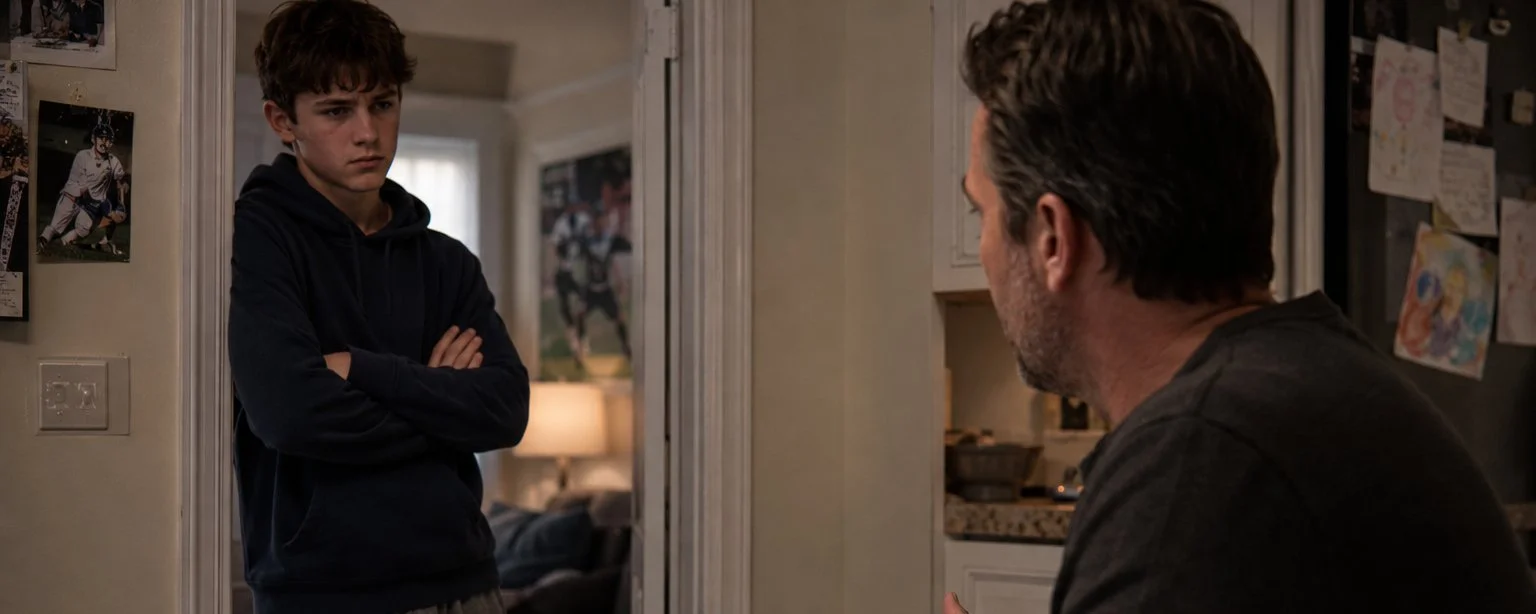
"Mom says you broke up the family."
Fifteen years old. Arms crossed in the doorway of the apartment he's decided he hates. Reciting a script he didn't write, in a voice that cracks halfway through because he's fifteen and this is his dad.
And dad does the worst possible reasonable thing. He defends himself.
Exhibits. Timelines. "There's a lot you don't know." Maybe he stops himself before the details about mom, maybe he doesn't. Either way he's now a defense attorney at his own kitchen table, submitting evidence to a judge who's a freaking sophomore in high school.
The guys I work with do this constantly, and I get why. He's been convicted in a court he wasn't allowed into. The story got told at mom's house, in the car, at grandma's, and by the time it reached the kid it had one villain. Sitting there taking it feels like pleading guilty. Every cell in his body says to correct the record.
Look at what correcting the record actually asks of the kid. It asks him to weigh his mother's story against his father's story and issue a ruling. That's the one job no fifteen-year-old should ever hold. Kids who get handed the judge's robe don't feel powerful. They feel torn in half, and they resolve the tearing the only way they can: pick a side and stop looking. Guess which side has the house, the school, the daily routine, and the meal schedule.
The numbers here are ugly and worth knowing. Adult children end up estranged from fathers at four times the rate of mothers. Twenty-six percent versus six. And about 70 percent of parents who get cut off got cut off after a divorce from the kid's other parent. The current does not favor dad. Arguing with the current drowns him faster.
But sit with the other number, the one nobody quotes: 69 percent of father estrangements end. Most of these freezes thaw. The question is what condition the relationship is in when the thaw comes, and that depends entirely on what dad does during the winter.
A field in winter looks dead. You don't stand at the fence yelling at it to grow. You don't dig up the seed every February to check on it. You keep the fence mended and you're there when the ground softens. That's the whole strategy, and it's brutal because it looks like doing nothing.
Doing nothing is not what it is. The winter playbook, from the guys who came out the other side. The text that keeps showing up and asks for nothing: "Saw the Lions took your guy in the second round. Love you." No guilt, no "Why didn't you answer," no counter-narrative. The attendance nobody thanks him for: the game, the concert, the pickup window, even when the kid barely grunts. The mouth kept shut about mom, permanently, even when the script gets recited word for word. Especially then. "I know it feels that way. I'm not going anywhere" beats any defense ever mounted. And his own work, on his own time: therapy, the men's group, the lifting, so the sadness doesn't curdle into the bitterness kids can smell from across a room.
One more thing he has to hear, and it stings. Some of the script is true. Maybe not the way she tells it, but a fifteen-year-old watched the family end, and dad was half of that family. "I made mistakes too, and you didn't deserve any of this" costs him nothing and gives the kid the one thing the war between his parents never offered: an adult who can hold blame without exploding or collapsing.
The kid recites the script because he's hurt and the script is the only container anyone gave him for the hurt. Dad's job is to be a bigger container. For years, maybe. Through the graduation where he sits three rows behind mom's family, through the phone that goes to voicemail, through the birthday text that gets a thumbs-up and nothing else.
March. June. Next August. Still there. That's the case. It's the only one that ever wins.
There's a whole room of dads in the Brotherhood living in that winter right now. Join us!